Matta raises $14m to built ‘sentient factories’
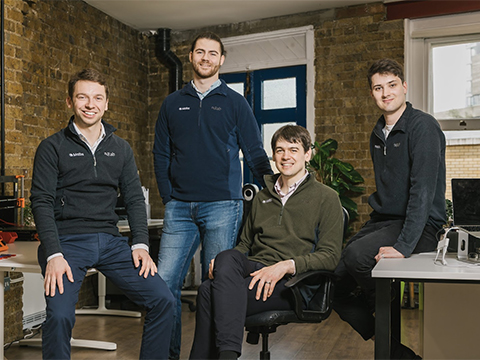 Matta, an industrial AI spin-out from the University of Cambridge, has raised $14M in funding to transform how products are designed and manufactured.
The seed round was led by Lakestar alongside investors Giant Ventures – who led the pre-seed – RedSeed VC, InMotion Ventures, 1st Kind (Peugeot family), Unruly Capital, and Boost VC, with grant support from Innovate UK and the Royal Academy of Engineering.
Matta’s AI gives factories the ability to see, understand, and improve themselves in real time, understanding any production line within days. It spots defects, traces root causes, and helps teams fix problems before they become costly.
The technology is generalist and highly adaptable, capable of working across everything from electronics and automotive to defence and apparel, whether on manual inspection stations, conveyor lines, or robot arms, to redefine how products are conceived and created. This generalisation capability is driving strong demand, with 300+ factories in the pipeline and a new installation every two weeks.
Doug Brion, Co-founder and CEO of Matta, said: “Everything around us is manufactured, from the mug on your desk to the optical cables carrying our Netflix binges. Everyone talks about the glamorous side of manufacturing: generative design, material discovery, digital twins, but few spend time on the factory floor.
“The hard part isn’t dreaming things up inside a computer; it’s making them work at scale. Manufacturing still runs on human know-how, the kind that let someone on the line kick a machine just right, or run a finger over a scratch, and say, ‘that’s thirty-four microns wide.’ We’re using AI to capture and scale that tacit knowledge, so engineers can design things that actually work in the real world. It’s time to manufacture the impossible.”
Manufacturing is at an inflection point
Manufacturing underpins a third of global economic output yet remains plagued by inefficiencies that waste up to 20 per cent of production value and raise emissions. After decades of deindustrialisation, factories are exposed to external geopolitical shocks and must do more with less. Matta provides a practical route to productivity, quality and resilience on today’s shop floor.
At the same time, energy costs are rising, supply chains are fragile, and workforces are ageing. Factories must reshore, decarbonise, and do more with fewer skilled hands. In the UK, vacancies already outnumber qualified engineers, and costs keep climbing. Across Europe and the US, the story is the same.
Building the first sentient factories
Matta develops AI that learns the physical rules of production and applies them on the line. Its first product uses unsupervised and self-supervised computer vision to automate quality control and anomaly detection, perform measurements, diagnose root causes, and recommend corrective actions in real time. A central platform lets teams monitor every camera, analyse results and trace parts across the factory for live visibility of issues and bottlenecks. Matta delivers this as a full plug-and-play system combining hardware, factory integration, AI research, and software. Most deployments are live within hours, with cameras inspecting automatically after a short learning period.
In one polymer manufacturing deployment, Matta achieved over 99% defect-detection accuracy with just ten minutes of data. Recent projects range from inspecting high-speed bottling for defects with a global drinks brand to working with Bowers & Wilkins, where Matta’s AI rapidly measures speaker components to catch issues before assembly.
Beyond detection, Matta partners with OEMs to enable machines to tune themselves. One of these OEMs, Caracol, is integrating Matta’s vision AI for closed-loop control, linking real-time inspection to automatic parameter adjustments on industrial printers and large-format robot additive manufacturing cells.