TUM partners with NEURA Robotics for training
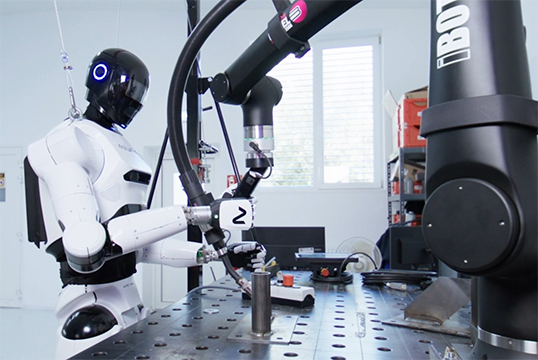 The Munich Institute of Robotics and Machine Intelligence (TUM MIRMI) at the Technical University of Munich (TUM) and NEURA Robotics are establishing the world’s largest robotics research and training centre.
Led by TUM MIRMI professors Lorenzo Masia and Achim Lilienthal, the project will develop and train hundreds of robot systems with AI support for future use in everyday life, many of them humanoid robots. The new robotics hub is being built in the TUM Convergence Centre as part of its TUM Industry on Campus strategy.
The partners are jointly investing €17 million in the TUM RoboGym. NEURA Robotics is contributing the lion’s share with eleven million euros, primarily to procure robots and maintain the hardware infrastructure.
“In return, NEURA Robotics participates in our research,” says Prof. Achim Lilienthal. “The interaction between high-end robotics technology and cutting-edge academic research in artificial intelligence will give development a huge boost.”
Lilienthal is the scientific coordinator of the new robotics hub “TUM RoboGym (powered by NEURA)” – a large-scale training facility where robots learn tasks from human demonstrations – and, together with Lorenzo Masia, initiated the new cooperation with MIRMI. The partners TUM MIRMI and NEURA Robotics have signed a cooperation agreement to establish the centre.
Humanoid robots are becoming part of everyday life
TUM President Thomas Hofmann emphasises: “Humanoid robots have long since left the realm of science fiction. In the near future, they will become an integral part of everyday life and support humans in many tasks. Together with NEURA Robotics, we at TUM aim to accelerate this development by advancing robot functionality while ensuring that humans and robots can live and work together safely.”
David Reger, founder and CEO of NEURA Robotics, says: “The decisive competitive factor in intelligent robotics is no longer mechanics, but data. Those who have high-quality, realistic training data set the pace. We at NEURA Robotics contribute our strength by establishing robot gyms worldwide and connecting training data through our Neuraverse platform, creating scalable training infrastructures for physical AI. Together with TUM, we combine excellent research with entrepreneurial implementation. In this way, we are setting new standards in intelligent robotics and strengthening Germany and Europe’s technological leadership in this key future field.”
Prof. Lorenzo Masia, Director of TUM RoboGym and Executive Director of TUM MIRMI, sees the cooperation as an opportunity to help shape the future of robotics worldwide: “European sovereignty is extremely important in times of geopolitical competition between East and West. With this research and training centre, which is one of the largest in the world, we are providing our researchers and students with a unique infrastructure in Europe where they can experience, create and learn new approaches to robotics and AI, and become a solid core of European experts when they enter the job market.”
Gaining valuable training data from human movements
At the TUM Convergence Centre at Munich Airport, the partners are conducting joint research on the next generation of humanoid robots in a 2,300-square-meter facility. The centre will develop AI-supported training methods for robotic systems. TUM MIRMI and NEURA Robotics will make most of the data generated at the centre available to the robotics community through an open ecosystem.
Unlike language models such as ChatGPT, embodied AI cannot draw on vast amounts of data from the internet for training. Web videos featuring robot arms performing specific tasks, for example, are hard to find. Moreover, it is still unclear how reliably movements can be interpreted from video data. Simulations also remain too imprecise and cannot accurately reproduce real-world effects such as friction.
“This is why we need a training centre where people can teach robots individual skills, such as folding a box or assembling components,” says Prof. Lilienthal. “In RoboGym, robots will learn general capabilities that they can then independently apply to specific tasks.” This requires large amounts of data, which are now being created in RoboGym by human trainers working with the robots.