Cobot motion and sensing for extended automation
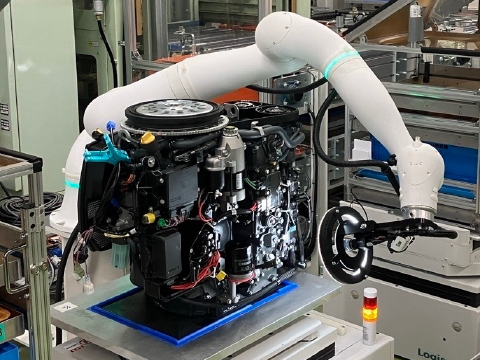 The latest advances in technologies such as sensing, actuation, and perception are enabling cobots to tackle more complex and delicate processes in manufacturing and logistics activities, as the experts at Yamaha Robotics explain.
Companies operating factories and warehouses can now choose from a wide variety of robots, ranging from familiar industrial types like cartesian and SCARA robots, cobots in various sizes and industrial grades, and humanoid robots are expected to begin trials in some factories soon.
Among this diversity, the cobots segment has seen sustained and growing interest from businesses keen to combine the strengths of robots with human workers, acting collaboratively, to optimise productivity. The typical cobot form factor, as a multi-articulated robot arm, has quickly become widely accepted and adopted. These robots are well adapted for picking, placing, and packing tasks. The sizes available range from compact desktop units with a reach of less than half a metre and carrying capacity of around 1kg to floor-standing sizes capable of handling larger, heavier items.
The 6-axis cobot is a popular design that can closely mimic the movement of the human arm. The 6-axis cobot comes very close to matching the dexterity of the human arm. Standardised flanges for end-of-arm tooling (EOAT) provide a practical mounting option for end-effectors whilst also simplifying interoperability and interchangeability.
While all this comes impressively close to replicating the movement of the human arm, six axes cannot capture the full range allowed by human joints. By introducing an extra 360-degree swivelling joint in the cobot’s lower limb, between the second and third axes, a 7-axis machine can more closely emulate the human arm’s abilities.
Importantly, a 7-axis machine can reach locations within the overall movement envelope that a 6-axis robot cannot touch. A critical skill is to reach around obstacles or to work on both sides of a large assembly without repositioning the workpiece. This can allow production planners and programmers extra flexibility to optimise the workspace layout and the sequence of actions for the cobot to complete the desired task.
Extending torque control
While designing this extra axis into the lower limb for greater movement flexibility, Yamaha Robotics has also integrated miniaturised joints built with a hollow shaft to further enhance the flexibility of its 7-axis cobot.
In the cobot, the hollow joints make it possible to integrate a torque sensor in each of the machine’s axes. This contrasts with typical cobot design approaches, which tend to include torque sensing only in the upper part of the machine. The extra sensors enhance overall control, permitting increased movement precision that lets the cobot address a wider range of applications.
Some examples of the diverse types of processes these cobots can handle, leveraging the extra motion data extracted from all-axis torque sensing, include mating electrical connectors, building delicate assemblies, buffing, polishing, and deburring.
Connector mating demands fine motor skills when performed by human operators in conventional production lines. With the ability to handle this complex and delicate task, the cobot can bring greater automation to assembly areas and elevate productivity in ways that have been difficult or impossible to achieve before now.
In addition, the cobot can handle processes like deburring mechanical components after machining or drilling. Also, where buffing and polishing call for delicacy as well as precision, the extra torque sensors on-board Yamaha’s 7-axis cobot let the machine polish either curved or flat surfaces with care. It is thus suitable for use in final assembly of products such as optical equipment or for handling and packing decorative items, or cleaning and drying items to restore surface finish after washing.
Cobots with torque sensing on each axis can also enhance safety by reliably and instantly detecting contact with an obstruction of any kind, such as a human worker or other obstacles in the industrial environment.
Verified safety, flexible operation
The Cobot meets functional safety standards and is certified by the independent authority TUV SUD. Prior to its official launch, Yamaha Robotics introduced the system in its primary outboard motor production site at the Fukuroi South Factory in Japan. The production teams at Fukuroi helped to validate the cobot’s operation and functionality under real production conditions.
The 7-axis machines were integrated in accordance with the applicable safety standards, ISO 10218 that specifies limits such as force, pressure, and speed in processes that allow contact between cobots and human workers. ISO 10218 contains recent updates that apply specifically to robots’ collaborative modes.
If cobots are used for processes that involve no contact with humans, in guarded areas that are separated and protected with safety interlocks, the standards allow operation up to full industrial speeds. The Yamaha 7-axis cobot provides high-speed operating modes for use where conditions allow, enhancing flexibility for owners to address a wide range of applications.
Incorporating a seventh axis delivers a significant advantage for collaborative robots, permitting improved functionality and safety. As demands for automation continue to grow worldwide, as industries seek ever greater productivity, cobots that offer a seventh axis opportunities can provide greater flexibility to address demanding applications and even address unexplored opportunities. With the enhanced motion control made possible by extending torque sensing, these can include processes previously considered too difficult for typical models.
Visit the Yamaha website for more information