Smart profile sensor solves space problem
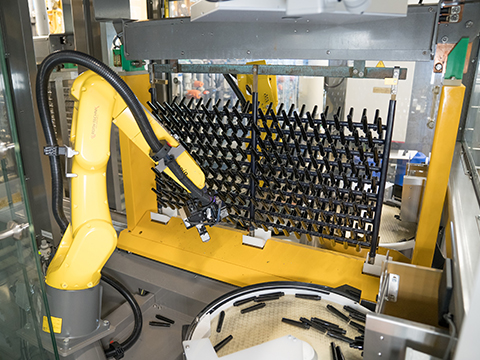 When electroplating is carried out manually, it requires a considerable amount of space and human resources. Using a smart profile sensor from Baumer, the Swiss automation company Roth Technik has developed a fully automatic system for plating racks.
Boxes containing small metal parts are stacked to the ceiling in a narrow bay resulting in barely enough space to manoeuvre a single pallet between the wall and liquid tanks. Behind this assembly, there are rows of tightly packed electroplating tanks.
On the electroplating floor of Collini’s Swiss site near Zurich, Switzerland, space is certainly at a premium. That is why the company, which specialises in surface coatings, was looking for a space-saving solution that would give it a fast and reliable way of hanging small parts on racks for the electroplating bath. The conventional method of loading the racks by hand requires a lot of space and human resources because several racks need to be loaded at the same time.
“For that reason, we wanted to switch to a new coating system with automated loading,” explains Marco Fuchs, Head of Product Engineering at Collini. Since a system of this type has yet to be created, he embarked on a search for companies that would have the pioneering spirit to accept the challenge.
Fuchs found the right partner in Swiss automation company Roth Technik, which in turn relies on smart sensor solutions from Baumer for its projects. A specialist in smart, bespoke automation solutions, Roth Technik collaborated closely with its customer Collini to develop a fully automatic and compact loading line.
At the heart of the line are four robots that automatically load parts onto the empty hooks on the racks. The biggest challenge for the system to overcome was the fact that no two racks are the same. The hook positions are not located exactly in the same place on the welded racks every time, and some hooks may be bent, or missing entirely. This is not a problem for human personnel to deal with, but it is very much for robots that require precise positioning data. The enormous variety and high throughput of parts presented two more challenges.
Robots guided efficiently by a smart Baumer sensor
So how did the Roth Technik team solve the problem of rack position inaccuracy, enabling the robots to learn the exact positions of the hooks for each rack?
The development team found a simple yet effective solution in the compact OXM200 profile sensor from Baumer. Mounted on the robot arm, it detects the exact position of each individual hook as it moves down the rack and reports this back to the robot control. With the help of a camera, the robot then picks up one part after the other from the separating carousel and hangs it on a hook. The robot uses the position coordinates previously collected by the profile sensor to finely adjust the position of the part. This method is what enables the smart profile sensor to guide the robot precisely and quickly on the electroplating rack.
To begin with, Markus Roth’s team tested various solutions with camera-based systems and other laser-based scanners. “In the end, we went with the profile sensor from Baumer because it was the best solution for our strict requirements regarding accuracy, compact design, and ability to detect objects,” states Markus Roth, CEO of Roth Technik. The compact OXM200 reliably detects the thin hooks and is still able to scan several hook positions at the same time. Using the control, it then decides whether or not to load the hook.
Thanks to powerful, integrated measuring tools, the sensor outputs measured the values for the X and Z coordinates directly in mm, significantly reducing the number of calculations in the control. The conclusion is that these smart ultra-compact profile sensors are ideal in applications where space is at a premium, whilst eliminating the need for additional human resources.
Visit the Baumer website for more information