Strong growth forecast for cobot shipments
Shipments of collaborative robots (cobots) are predicted to grow at an average annual rate of 17.3% from 2025 to 2030. According to the latest market report from Interact Analysis, shipments will almost double over the forecast period to 128,918 units. This follows a positive 2025, with shipments of cobots increasing 14.5% to approximately 57,000 units and market revenue growing by 10.5%, from around $1.1 billion to more than $1.2 billion.
The market intelligence specialist reveals growth was primarily influenced by large-scale equipment upgrades in the electronics manufacturing industry, cyclical recoveries in the semiconductor industry, and increased automation penetration in logistics and warehousing. Falling barriers to entry for consumers have also driven adoption, while improved safety, ease of use, and cost reductions have also contributed to the rise in shipments seen in 2025.
Between 2025-30, Interact Analysis forecasts strong revenue growth, with an average annual increase of 13.6%, expanding to more than $2.3 billion in 2030. The gap between shipment and revenue growth indicates a downward trend in the average selling price. However, the rate of decline is predicted to be slow compared with previous years due to the stabilization of the price war in China and rising manufacturing costs in Europe and the US.
China continues to dominate market share
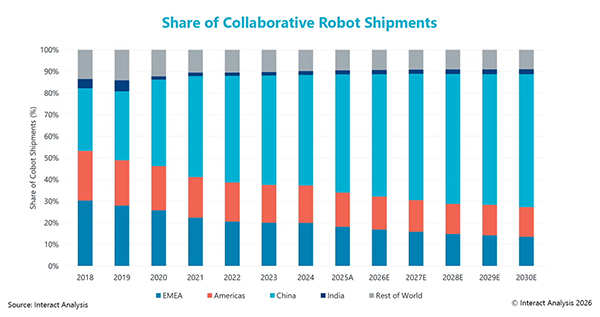
China’s dominance in the collaborative robot industry continues, with its year-on-year growth consistently outpacing other major regions. In terms of shipments, Interact Analysis reports China’s market share rose from 28.9% in 2018 to 54.7% in 2025, with forecasts suggesting it could reach 61.4% by 2030. In contrast, market share of the Americas is projected to fall from 15.9% to 13.7% between 2025 and 2030. Meanwhile the EMEA region is expected to drop from 18.1% to 13.5% over the same period, to be narrowly overtaken by the Americas.
China’s revenue share of the collaborative robot market is predicted to increase from 35% in 2025 to 42.4% in 2030, representing an average annual growth rate of 17.8%, compared with 11% for the rest of the world. China’s rapid revenue expansion can be explained through volume advantage, as well as lower average unit costs. Prices are beginning to stabilize in China after several years of intense price competition, with average revenue per unit decreasing by just 0.35% in 2025, compared with 7.9% in 2024.
High payload cobots are experiencing strong growth
Interact Analysis’ Collaborative Robots report indicates the industry is shifting toward medium and high payload ranges, aligning with the rise in ‘industrial cobots’. Traditionally, cobots have focused on light payloads of 10 kg and under, however the market is increasingly expanding into the 16-20 kg and >20 kg segments, blurring the lines between cobots and industrial robots.
Samantha Mou, Senior Analyst at Interact Analysis, explains, “This upward payload shift aligns closely with vendor product strategies. Examples include ABB’s PoWa series for the Chinese market and JAKA’s 40 kg model (with a 90 kg model in development), both designed with higher payloads and reduced force control precision. These ‘industrial cobots’ essentially penetrate traditional industrial robot applications while retaining collaborative safety features, targeting scenarios such as automotive parts, metal processing, and warehousing and logistics that require high payload, cost effective automation.”