Robotic bin picking drives strong market growth
As warehouse automation continues to evolve, the use of stationary robots with robotic arms for picking and handling tasks (including palletizing, depalletizing, and item or case picking) is developing rapidly. In its latest report, Robotic Picking 2026, Interact Analysis estimates the market size for robotic picking in 2025 at $1.7 billion, projected to reach $4.6 billion by 2030, growing at a compound annual growth rate (CAGR) of 21.7% during the 2026-2030 forecast period.
Emerging technologies are reshaping the market
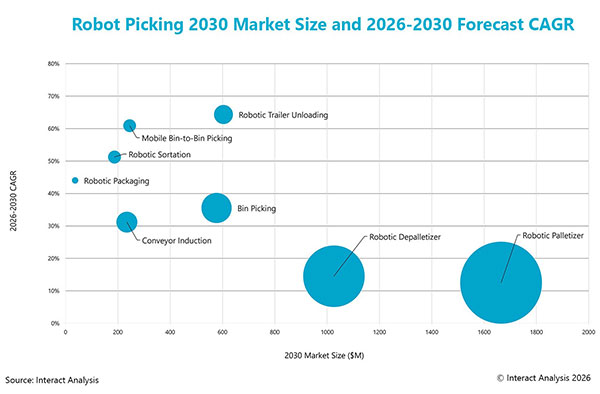
In 2025, the bulk of these applications were robotic palletizing and depalletizing, which represented 83% of the total robotic picking market. This is a relatively mature application segment, with robotic palletizing and depalletizing having been used in warehousing for several decades, including in large-scale automation deployments. However, the market structure is expected to shift gradually over time.
By 2030, the combined share of robotic palletizing and depalletizing is forecast to decline to approximately 58% of the total robotic picking market, as newer applications such as bin-to-bin picking and robotic trailer unloading gain traction. “During our forecast period, robotic bin picking is projected to grow at a 36% CAGR from 2026 to 2030, while robotic trailer unloading is forecast to grow at 64% CAGR over the same period,” says senior analyst Irene Zhang.
Robotic bin picking and robotic trailer unloading
Robotic bin picking’s integration into modular solutions has lowered integration complexity, increasing customers’ willingness to deploy. As an add-on solution, robotic picking systems need to integrate with existing workflows, as well as with WMS or WES, which poses an adoption challenge for warehouse operations. “We are seeing a trend toward modular solutions that lower the complexity of integration, with examples including AutoStore’s built-in picking solution – VersaAI Workstation, and Ocado’s on-grip picking,” says Zhang.
Robotic trailer unloading, with its relatively standalone solution and addresses a segment where customers have an urgent need for automation. “On one hand, we see large orders emerging in this market, which improves customer confidence in the maturity of the technology,” says Zhang. “For example, DHL announced plans to deploy more than 1,000 additional Boston Dynamics Stretch robots globally, building on Stretch’s initial use for trailer unloading. UPS has also reportedly planned to invest around $120 million in approximately 400 Pickle robots for truck unloading, highlighting the growing interest in automating one of the most labour-intensive processes at the warehouse dock.
“Our own Voice of Market research points in the same direction: 43.4% of respondents identified receiving and unloading as a priority workflow in their automation roadmap.”
Palletizing evolving beyond traditional applications
Even within the relatively mature palletizing segment, the market is evolving. In recent years, we have seen growing interest in inbound palletizing, where floor-loaded shipments are palletized after unloading before being moved into storage. This reflects the increasing demand for automation across inbound warehouse processes, rather than focusing solely on outbound palletizing. The growing number of partnerships and technology collaborations also highlights this shift. Recent examples include Pickle and Ambi Robotics, as well as the Boston Dynamics and Jacobi Robotics demonstration at 2026 MODEX, highlighting how robotic unloading and palletizing are increasingly being combined into integrated solutions.
How is the competitive landscape evolving?
“We’re seeing a corresponding shift in the competitive landscape,” says Zhang. “Specifically, we’re seeing shifting shares in robotic bin picking, with vendors offering trailer unloading robots accounting for a larger share of the overall robotic picking market.
“Emerging robotic bin-picking providers are gaining share from the early pioneers in the market. Companies such as Ocado, Nomagic, and Sereact are gradually increasing their presence in the robotic bin-picking market and capturing a growing share as adoption expands. Trailer unloading is also creating new opportunities for market share growth. The rapid growth of robotic trailer unloading is reshaping the competitive landscape. As this application expands, companies offering trailer unloading solutions are naturally gaining a larger share of the overall robotic picking market.
“Overall, robotic picking is gaining greater visibility and acceptance across the warehouse automation space,” she concludes. “As adoption expands beyond traditional palletizing and depalletizing applications, robotic picking is expected to become an increasingly important component of warehouse automation. We forecast that by 2030, robotic picking will account for 10% of the total warehouse automation market, up from just 5% in 2025.”