Data centres driving growth for robotics
Rapid growth in data centre capacity is accelerating investment across the supporting supply chain. Research from Interact Analysis finds that as more facilities are built and expanded, greater volumes of servers, racks, components, and spare parts must be stored, staged, integrated, and moved; creating downstream demand for material handling equipment and warehouse automation.
The opportunity for material handling equipment vendors extends beyond the data centres themselves to the wider network of supporting facilities.
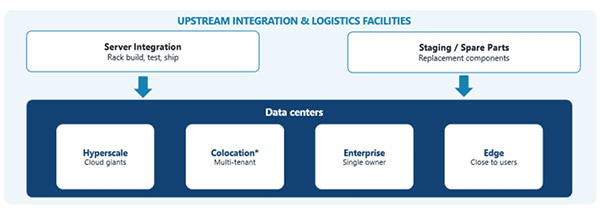
Data centres sit at the core of the ecosystem and vary by use case, scale and operating model. Broadly, they can be classified as hyperscale, colocation, enterprise or edge facilities.
Hyperscale data centres are very large facilities operated by major cloud and internet companies; colocation facilities provide shared space, power, cooling and connectivity to multiple customers (broadly analogous to a third-party logistics model); enterprise data centres support the requirements of a single organisation; and edge data centres are smaller facilities located closer to users and devices to reduce latency.
Server integration facilities
Server integration facilities assemble, configure and test complete server racks before shipping them to data centres, reducing on-site installation time and accelerating deployment and replacement cycles. Although rack integration was historically performed on-site, server OEMs (such as Dell, HP, and Supermicro) and contract manufacturers (such as Foxconn) have increasingly adopted off-site ‘rack-and-roll’ models. Integration is also moving toward regional facilities, sometimes operated by third-party logistics providers such as GXO or DHL and located closer to data centres, to shorten delivery lead times.
Spare parts/staging facilities
Spare parts and staging facilities act as consolidation centres, sourcing components from multiple OEMs for both the build out and the replenishment of spare parts. Historically, these tended to be operated by equipment OEMs, with each OEM shipping their components to data centres. However, a growing number of hyperscalers now use dedicated, multi-vendor spare-parts and staging hubs that consolidate inventory and fulfil orders against increasingly demanding service-level agreements.
Opportunities for material handling equipment and automation
It’s important to understand the various opportunities for material handling equipment and warehouse automation across the ecosystem, as not all facilities will be attractive targets for vendors. The table below illustrates the various facilities in the ecosystem and the types of material handling and automation equipment in which each facility typically invests.
Interact Analysis research suggests that spare parts and staging facilities present the largest opportunity for warehouse automation vendors. Initial research discussions with vendors referenced warehouse automation RFPs for single sites exceeding $100 million for a single facility, as hyperscalers look to drive efficiency both during the build-out and to maintain uptime. On the other hand, investments in robotics within data centres themselves hold a lot of potential, although this will likely remain unrealised in the short- to mid-term, given the complexity of the various tasks required.