The evolution of vision in robotics
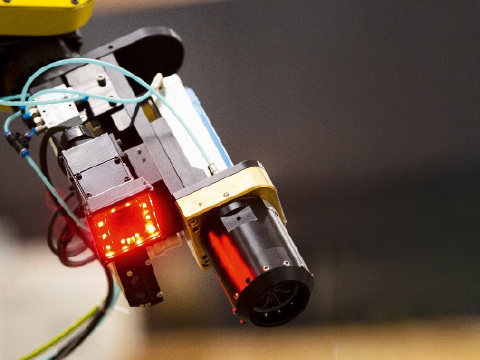 Vision technology has long played a pivotal role in robotic solutions, helping manufacturers to increase efficiency and accuracy in applications such as quality checking, measurement and product location. However, recent developments in vision innovation, combined with a lowering of costs, means that this is now a great time to invest in robotic technology with vision capabilities, Oliver Selby, head of sales at FANUC UK explains.
Going back a few decades, PC-based vision was the norm. PCs were in control of the camera, meaning that the processing power was in the computer, not the camera itself. This evolved into the development of robots with in-built vision technology, employing solutions such as FANUC’s IR vision – a fully-integrated 2D and 3D visual detection system that enables FANUC robots to see.
More recently, however, there has been shift towards smart cameras and, in more complex scenarios, industrial PCs combined with AI. For simple applications, smart cameras are proving highly effective for enabling robots to locate parts, complete measurements, or carry out basic quality checks.
For more sophisticated tasks, the high processing requirements of high speed or very high accuracy vision systems require an industrial PC. When it comes to high-speed robotic vision applications, such as recognition of different products and different materials at speeds that can match the robot’s capabilities, it is becoming increasingly common for AI technology to be employed.
One such example is London-based recycling tech company, Recycleye. It uses proprietary AI vision technology in conjunction with FANUC 6-axis LR Mate robots to automate the detection and sorting of mixed recyclables. Previously a mostly manual process, Recycleye is generating impressive results including an increase in sorting accuracy of up to 12% and improved line output of up to 10%. Not only is this helping waste operators to boost their bottom line, it’s also providing a solution to the ongoing labour shortages in the waste management industry.
As Recycleye is proving, vision cameras are making robotic deployment in difficult tasks more reliable than ever before, validating and verifying location, product quality and part placement. Not only that, but costs have come down significantly in recent years, so much so that industrial vision is now at a price point that compares with smart sensors. As a result, inbuilt vision technology is now a standard feature of most robot systems, rather than an additional add-on at extra cost.
Latest advances in camera technology also means that today’s robotic vision systems operate more robustly and reliably in 2D and 3D applications and in environments that traditionally have been difficult for cameras to operate in. For example, in the past, vision technology used only visible light and relied on pattern matching or model matching as a means to locate or identify a part. Modern vision technology can now use different wavelengths, or stereovision to improve reliability, filtering out the challenges caused by sunlight or other environmental effects, as well as process interferences such as welding sparks.
As for the next big trend, I believe there will be a shift towards the use of industrial camera solutions for safety rather than traditional solutions such as light guards, in order to better manage robotic safety around humans in collaborative applications. Although this technology has been available for a while, it hasn’t been utilised at scale because it was prohibitively expensive for most applications. This is now changing, and affordable industrial camera solutions from companies such as SICK are set to revolutionise robot safety as we know it.
In addition, we can expect to see more and more smart camera systems as standard features on established robot models. For example, Mech-Mind’s 3D smart camera technology is already being integrated with FANUC robots, enabling end users to benefit from its ability to see even dark and reflective objects, and locate transparent parts.
Visit the FANUC website for more information