Resilient connectivity for robotic warehouses
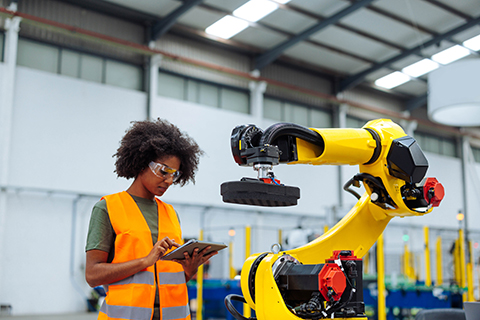 Lee Slater, European operations manager at industrial connector specialist PEI-Genesis discusses the importance of connectors in increasing the efficiency and reliability of modern warehouses.
Robotic warehouses increasingly function as fast-evolving ecosystems in which data, power and motion interact continuously. Autonomous mobile robots, robotic picking units and high-speed sorting systems all depend on uninterrupted communication and power delivery to operate safely and efficiently. In this environment, the connector becomes a critical component rather than a passive interface.
Within automated warehouses, connectors face a level of dynamic stress rarely encountered in traditional, stationary industrial environments. Constant vibration, rapid acceleration and deceleration, repetitive docking cycles, cable flexing and electromagnetic interference from dense motor activity create an environment where weak interconnects fail quickly.
A connector suitable for a stationary control panel may degrade rapidly on a robot executing continuous manoeuvres across multiple shifts. True resilience requires connectors that maintain electrical integrity while resisting mechanical wear, environmental contamination and fluctuating thermal loads, even as data and power requirements grow more complex.
Built for autonomous performance
Modern robots integrate machine vision, advanced sensor arrays and edge-processing modules that rely on stable high-speed data transmission. High-density connector formats with carefully controlled impedance and precision-engineered contacts provide the channels needed for these workloads while protecting signal integrity under motion and vibration.
As data rates increase and robots process more information at the edge, these interconnects must also manage electromagnetic compatibility challenges, ensuring that dense clusters of wireless and wired systems can coexist without cross-talk or latency-inducing interference.
A recent robotics industry analysis noted a surge in the deployment of AI-driven humanoid and mobile robotic systems in logistics and production, emphasising that their adoption is contingent on reliable, interference-resilient communication infrastructure. This showcases the shift towards connectors that are not just rugged but engineered for environments where data is as mission-critical as power.
Mechanical resilience remains equally important. Robotic warehouses rely on frequent battery changes, automated docking and continuous interaction with charging infrastructure. These applications require connectors capable of thousands of mating and unmating cycles without significant wear to contacts or housings.
Advanced sealing technologies, such as IP67 or IP69K-rated housings with overmoulded gaskets shield connectors from dust ingress, moisture and the fine particulate matter that circulates in busy logistics hubs. At the materials level, engineered alloys like nickel-plated brass, stainless steel or hard-anodised aluminium, combined with corrosion-resistant contact platings such as gold or palladium-nickel, provide durability against oxidation, abrasion and thermal cycling. The result is an interconnect designed to operate as a long-life component of the robotic system rather than a consumable accessory.
Prepared for tomorrow’s robotics
The next generation of robotic warehouses will place even greater demands on interconnect systems. As fleets scale and facilities integrate more autonomous functions, connectors will increasingly serve as the physical foundation for modularity and upgradeability. Connector families designed with consistent geometries and scalable contact counts enable manufacturers to add processing units, expand sensing capability or incorporate enhanced communications modules without redesigning entire platforms.
This theme is reflected across the automation industry. A 2025 workforce study on warehouse robotics found that 98 per cent of workers report productivity improvements in automated facilities, but also that operational success depends on reducing unplanned downtime, much of which originates at electrical interconnect points rather than software or mechanical faults. The reliability of connectors has become a top-tier priority for organisations scaling robotics at speed.
Power architecture is also undergoing transformation. Robots now carry heavier computational loads, more advanced sensing arrays and increasingly energy-hungry machine-vision systems. Meanwhile, operators push for accelerated charging cycles, extended run times and reduced energy loss during peak operation.
This combination drives demand for connectors capable of managing higher current densities with precise thermal dissipation properties and robust insulation. Customisable assemblies, an area where PEI-Genesis maintains deep expertise, ensure that connectors match the exact electrical and thermal requirements of each robotic platform instead of relying on generic configurations.
As warehouses transition into fully autonomous, high-bandwidth environments, the performance of the interconnect layer becomes inseparable from the performance of the robots themselves. Every navigation decision, sensor update and charging cycle relies on connectors engineered to withstand constant motion, electrical noise and environmental stress.
Going forward, the real differentiator in warehouse automation will lie in how effectively these physical interfaces support scalability, uptime and system longevity. With the right connector strategy, operators can build robotic fleets that are not only faster and smarter, but far more resilient to the demands of continuous operation.