Humanoids could add 30% to cobot arm TAM
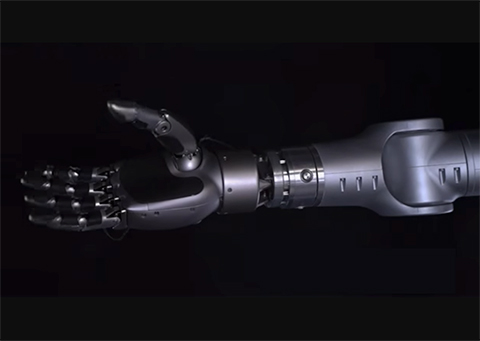
Rokae humanoid robotic arm AR Series
A growing number of collaborative robot arm manufacturers have moved from isolated pilot projects to volume supply to humanoid robot developers. What began as occasional component sales is evolving into a structural trend for the cobot industry. For cobot vendors, this is a logical, low risk extension of their core technology, offering a promising secondary growth avenue without immediately cannibalizing existing cobot business.
According to research from Interact Analysis, while near term revenues remain modest, the long-term upside could be huge, potentially adding 10% to 30% to cobot vendors’ revenues by 2030.
While both China and the United States have humanoid production capabilities, only China possesses a fully integrated collaborative robot (cobot) manufacturing ecosystem and a mature supply chain. This unique advantage allows Chinese cobot manufacturers to capture demand benefits from the humanoid robotics boom right from the start – whereas the U.S., despite having production, lacks the same end‑to‑end industrial readiness.
Large-scale orders signal a structural shift
Recent months have seen a surge in cobots sold to humanoid makers. These are volume purchases, not small-scale evaluations, indicating that humanoid developers increasingly rely on mature cobot technology to accelerate their roadmaps. Cobot grade actuators, force sensors, and control architecture are already industrially proven, allowing humanoid makers to bypass years of internal R&D.
Several Chinese cobot vendors have formally disclosed long-term supply relationships:
- Rokae supplies humanoid arms to Agibot
- Huayan Robotics provides joint motors and actuators to multiple humanoid vendors
- Jaka stated in its 2025 IPO application that Agibot became a top five client in 2024, purchasing robotic arms
- Fairino announced that it is becoming a Tier 1 supplier for humanoids, offering actuators, arms, and upper bodies
- ZDL Robotics publicly announced a supply relationship with Galbot, delivering force-controlled arms
Other vendors such as Realman, Dobot, and Elite are reportedly engaging in similar businesses, though not all have made formal disclosures.
AI native startups and geographic concentration
A significant portion of new humanoid entrants are AI-focused companies founded by researchers from leading AI labs. They possess strong algorithms but have no prior robotics hardware experience or established manufacturing. Building an in-house supply chain from scratch is prohibitively expensive and time consuming. Instead, they outsource hardware; upper bodies such as arms and hands to cobot vendors, and lower bodies such as mobility bases to AGV or AMR suppliers.
This division of labour allows rapid iteration from concept to prototype to limited production. The number of such startups is still increasing, fueled by venture capital interest in embodied AI. Demand for cobot sourced hardware is, therefore, not temporary; new entrants continuously replenish the customer pool, reducing dependency on any single winner.
Humanoid development and assembly are overwhelmingly concentrated in China and the United States. China hosts the largest and most active humanoid startup ecosystem, including Agibot, Galbot, and UBTECH. This is supported by robust industrial supply chains, government initiatives, and a mature components industry. Chinese cobot manufacturers are physically and logistically close to these customers, enabling faster iteration, lower costs, and easier collaboration.
The United States is home to Tesla Optimus, Figure AI, 1X, and research labs like Boston Dynamics. However, there are fewer US cobot vendors and many US humanoid makers either develop actuators in house or rely on specialised component suppliers outside the cobot industry. As a result, mainland Chinese cobot manufacturers are the largest early movers and clearest beneficiaries. They enjoy a home market advantage: a dense cluster of humanoid OEMs needing exactly the hardware Chinese cobot vendors already produce.
This geographic asymmetry suggests that, at least through 2028, Chinese cobot vendors will capture disproportionate value relative to their international peers.
Three integration pathways
Supply relationships fall into three overlapping models:
- The first is core component supply. Cobot vendors, drawing on years of accumulated technical expertise in integrated joint modules, servo drives, torque sensors, and force torque sensing are becoming key Tier 1 suppliers in the humanoid robot supply chain. These core components were originally designed for compliance control and safe interaction in cobots, but they align closely with the requirements of humanoid joint actuators, which demand high precision, high responsiveness, and force control.
- The second is technology synergy. The upper body of a humanoid robot, particularly the arms and hands, shares fundamental technologies with cobots, including compliance control, gravity compensation, collision detection, and human safe interaction. This has led some cobot vendors to naturally extend their product lines from traditional cobot arms to complete humanoid robots. For instance, Rokae has launched its humanoid force-controlled arm and showcased a full-sized humanoid robot. Dobot has expanded from cobot arms to wheeled humanoids and full-sized humanoids. These vendors benefit from synergy in their technology roadmaps.
- The third is the application bridge. Before bipedal locomotion technology fully matures, many real-world humanoid applications will first be deployed in factories in the form of fixed base or wheeled dual arm cobots. The technical maturity of cobot arms, along with their proven reliability in industrial settings, provides humanoid manufacturers with a dual arm hardware option that is easier to deploy in industrial environments. Several leading humanoid manufacturers have identified industrial scenarios as their primary target for initial large-scale deployment. For example, UBTECH and AgiBot both aim to start mass production with industrial applications in manufacturing and logistics and have set targets of delivering over 5,000 units each in 2026.
Maya Xiao, Research Manager at Interact Analysis, says: “From a technology perspective, the trend creates positive synergies. Cobots and humanoid arms require similar capabilities in safety, compliance, force sensing, and ease of programming. Supplying humanoid makers accelerates real world testing and refinement of actuation and control algorithms, with potential spillovers into cobot product lines.
“The primary risk is distraction; if cobot vendors allocate disproportionate R&D or production capacity to humanoid components, an unproven mass market segment, they may slow innovation in their core cobot business.
“From a growth and revenue perspective, near term impact from 2025 to 2027 is positive but modest. It helps validate cobot hardware quality and provides a hedge against cyclical capex fluctuations in traditional automation. Chinese cobot vendors, given their geographic advantage, will likely see the earliest and largest contributions. In the long term, from 2028 to 2030 and beyond, this could become a material growth driver if humanoid adoption takes off.
“Currently, humanoid arms and actuators sell at higher unit prices due to low volumes and customization. As humanoid production scales, component pricing will face downward pressure. Cobot vendors with strong cost control, particularly Chinese vendors operating in a highly competitive domestic market, already possess world-class cost engineering capabilities.
“Humanoid robots are not direct substitutes for cobots in factory settings, at least not in the next five to seven years. Cobots are typically fixed or semi-fixed workcells, while humanoids are mobile general-purpose platforms. This means that the humanoids market is an additional revenue stream for cobot vendors, not replacement demand.”