“Self-reflective” robot recognises its limitations
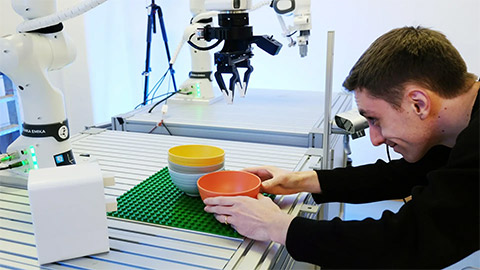 A new AI model developed by researchers at the Technical University of Munich (TUM) teaches robots to recognise their own limitations. When they encounter an unfamiliar situation they cannot handle, for example, they simply stop and wait for someone to help them. This enables robots to continuously learn new skills without forgetting what they already know or putting people at risk.
For an AI-controlled robot to navigate the real world, it not only needs to keep learning but must also realistically assess its own capabilities. A new AI model developed by a research team led by Ralf Römer and Prof. Angela Schoellig now combines both abilities in a single system. The researchers from the TUM Chair of Safety, Performance and Reliability use what is known as a vision-language-action model (VLA).
A VLA works much like ChatGPT, Claude or Gemini, but for the “real” world. It translates verbal instructions into robot actions, using current images from the robot’s cameras to correctly assess the situation. While conventional language models can draw on a virtually unlimited supply of text and images from the internet, there is no comparable wealth of data on robot movements. New data can be generated by demonstrating human movements to robots or by simulating them on a computer, but these methods cannot cover every situation a robot might encounter in the real world.
Smaller language models that can model movement
To enable the AI model to control movement in real time, the researchers build on comparatively small language models, such as Google’s open-source PaliGemma model. The advantage is that the time between a command and the robot’s response is significantly shorter than with much larger models such as ChatGPT and similar systems. However, movements learned and optimised from data are sometimes not precise enough to complete a task successfully. The AI model therefore assesses whether it is actually capable of performing the task it has been given.
“If the robot isn’t sure what to do, it simply stops,” explains Römer. This gives the researcher an opportunity to work through the unfamiliar movement with the robot, generating additional data in the process. “We specifically retrain the system on situations where it is uncertain,” says Römer. With this new method, he can reduce the amount of training required by up to 20%.
Targeted retraining within the same AI model
When the robot learns a new manipulation skill, it can do so within the same AI model, without the researchers having to switch between different AI models. This is new. “AI models change when they learn something new and can end up forgetting things they have already learned,” says Prof. Angela Schoellig, who holds leading roles at the Munich Institute of Robotics and Machine Intelligence (MIRMI) and the Robotics Institute Germany (RIG), in addition to heading her chair.
The model’s neural connections change, meaning that newly learned information competes with what was learned previously. As a result, the task is performed less precisely. To avoid this, Römer adds an adapter to the AI model whenever it needs to learn something new.
AI no longer forgets
The AI model incorporates the newly generated data, stores it as additional information in an adapter and uses it to improve the movement in question. This allows information about each new movement to be added separately. “There can be a large number of these adapters,” says Römer.
What is new is that the system uses exactly the adapter needed for each new task. An important additional benefit of these “self-reflective” robots is greater trust: “People who work with robots every day develop greater confidence in the systems and their safety,” says Schoellig.