Validating autonomous vehicle hardware
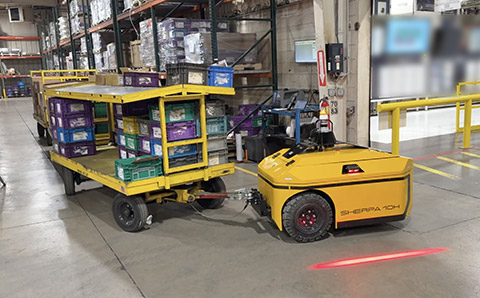 Ati Robotics, the US-based autonomous robotics company developing intelligent material-handling vehicles for industrial environments, is using SimScale’s AI-native cloud simulation technology to support hardware validation of its Sherpa autonomous mobile robot (AMR).
The engineering team uses SimScale to conduct structural and mechanical simulations of the Sherpa platform, assessing vehicle design and drive system components against the load, speed and reliability requirements of continuous factory-floor operation. The technology gives engineers the ability to investigate hardware performance virtually, supporting design validation without the infrastructure overhead associated with traditional simulation environments. SimScale also provides a common simulation environment for engineering teams working across the company’s US and India operations.
The adoption comes as manufacturers accelerate investment in robotics and automation to improve productivity, address workforce constraints and increase operational efficiency. More than 600,000 industrial robots were installed in factories worldwide in 2025, an 11% increase on the previous year, according to the International Federation of Robotics (IFR). The global operational stock rose 9% to a record five million. The US is also seeing renewed growth, with industrial robot installations increasing by 12% to approximately 38,500 in 2025, making it the world’s second-largest market behind China.
The investment reflects a wider shift in manufacturing towards more sophisticated engineering and automation capabilities. PwC’s 2026 Global Industrial Manufacturing Sector Outlook found that 78% of manufacturers expect robotics to deliver productivity improvements, while manufacturers anticipate the proportion of their processes that are highly automated will increase from a median of 18% today to 50% by 2030.
Labour shortages are also accelerating manufacturers’ investment in automation. Deloitte’s 2025 survey found that 48% of large US manufacturers faced moderate to significant difficulties filling production and operations roles. Autonomous systems, including AMRs and UAVs, can help address these pressures by automating repetitive tasks such as material movement, inspection and equipment monitoring, reducing reliance on workers and helping maintain productivity.
As these technologies take on a greater role in manufacturing operations, ensuring that autonomous vehicles can perform reliably under demanding and changeable operating conditions is becoming an increasingly important engineering challenge. For Ati Robotics, ensuring its autonomous vehicles are engineered to meet the demands of real-world industrial environments is central to growth.
“Designing an autonomous vehicle that operates reliably in continuous production environments requires rigorous hardware validation,” said Venkatesh Prasad, Head of Mechanical Engineering at Ati Robotics. “SimScale gives our team the ability to run structural and dynamic analyses without the infrastructure overhead that would slow down our development cycle.”
“Ati Robotics is building the autonomous material-handling infrastructure that modern manufacturing needs to stay competitive,” said David Heiny, CEO at SimScale. “Their approach, using cloud-native simulation to support hardware validation across engineering teams in the US and India, demonstrates how access to advanced engineering tools can help ambitious robotics companies develop and validate increasingly sophisticated physical products.”